How to Write a Monthly Competitor Report That Drives Decisions
Learn how to write a monthly competitor report that leadership will actually read. Includes a practical reporting structure, examples, and tips for identifying meaningful competitive changes.

Kaavian Sivam · Founder @ Ulavu
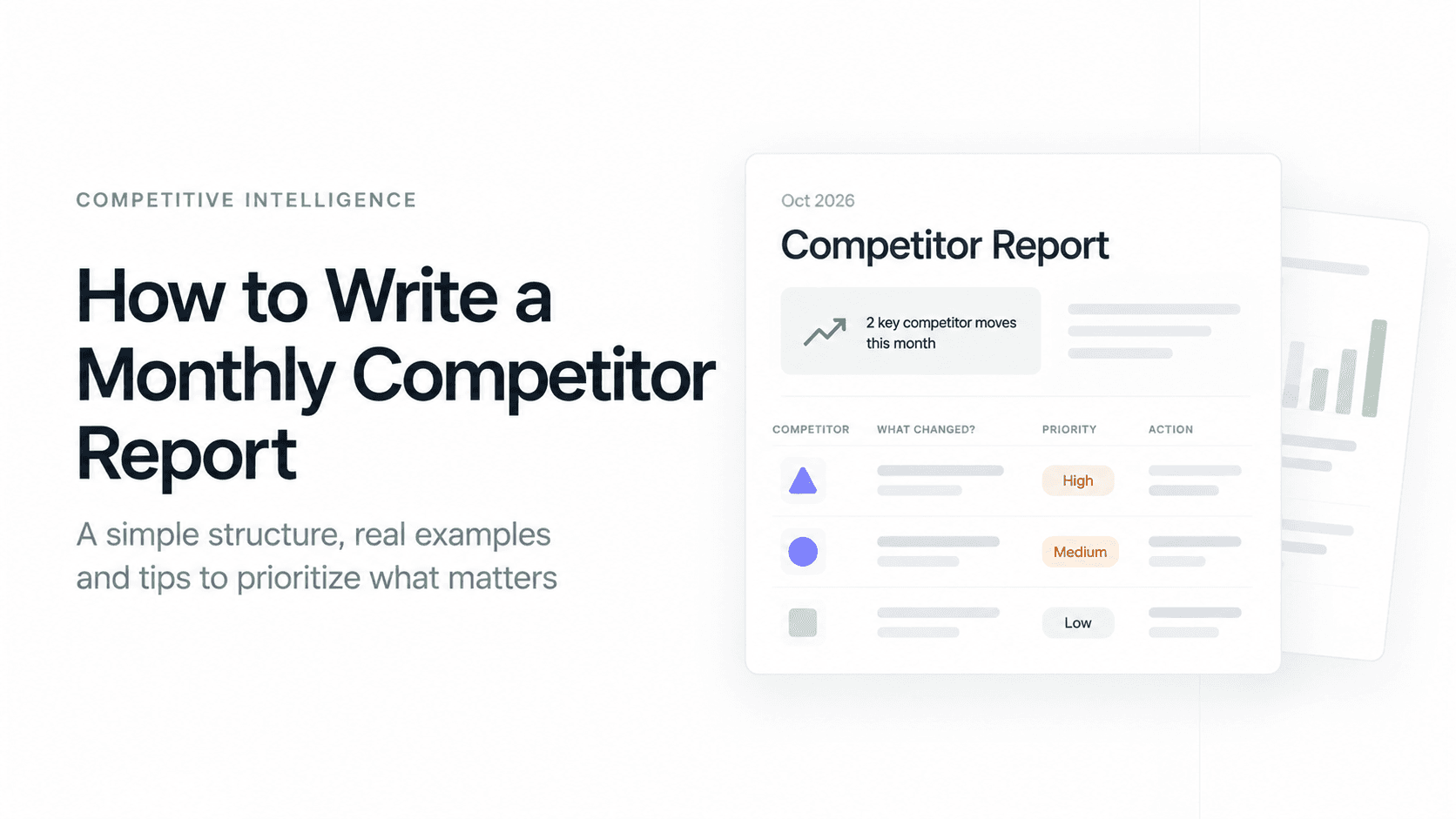
Most competitor reports I've come across have one thing in common: they're filled with information, but very little of it tells you what to do next.
You'll find competitor announcements, product launches, pricing changes, screenshots, and sometimes even a detailed feature comparison. By the time someone finishes reading it, they know a lot about what competitors have been doing, but they might still struggle to understand why any of it matters.
For product marketers, especially in smaller B2B companies, this is a familiar problem. You spend hours collecting competitive information, only for the report to be skimmed during a meeting and forgotten.
A useful competitive intelligence report should help leadership understand what changed in the market, how it affects the business, and whether any action is necessary. Here's how I'd structure one without turning it into another time-consuming research project.
Why do most competitor reports go unread?
One reason is that competitive reports often become a collection of everything that happened during the month. Every product announcement, website change, and new feature finds its way into the document, regardless of its relevance.
Another problem is the lack of context. Reporting that a competitor has launched an integration is useful information, but leadership will naturally have follow-up questions. Does it affect our customers? Is it something prospects have been asking for? Does it change how we position our product?
If your report doesn't answer these questions, someone else needs to investigate the findings before making a decision. That's additional work for everyone involved.
The objective should be to reduce the amount of information leadership needs to process while preserving the details required to make informed decisions.
What should a monthly competitor report include?
For most B2B SaaS teams, I'd recommend keeping the main report to one or two pages. You can always maintain a separate document containing detailed research, links, and screenshots.
The main report should cover five areas.
1. Executive summary
Start with the two or three most important competitive developments from the month. This gives leadership a quick understanding of what's happening without requiring them to read every observation.
Prioritize changes that could influence your positioning, pricing, product strategy, or sales conversations. If nothing particularly significant happened, mention that rather than trying to make routine updates sound important.
2. Important competitor changes
Document what changed and when you discovered it. Include pricing updates, new features, positioning shifts, product launches, or other developments relevant to your business.
Where possible, include a link to the announcement or a screenshot showing the change. This gives readers a way to verify the information without cluttering the main report.
3. Business implications
This is probably the most important part of the report. Explain why each development deserves attention and how it could affect your business.
For example, a competitor introducing a cheaper subscription plan matters only if it targets customers who would otherwise consider your product. If the new plan serves an entirely different segment, there may be little reason to respond.
4. Recommended actions
If a finding requires action, explain what should happen next. This might involve updating competitive sales materials, investigating a product gap, reviewing pricing, or speaking with customers.
Not every observation needs a recommendation. Sometimes the appropriate response is to keep monitoring the development until you have more information.
5. Supporting evidence
Finally, make sure readers can verify important claims. Link to pricing pages, product announcements, documentation, or dated website screenshots.
It also helps to distinguish between something you've confirmed and an interpretation that still needs validation. A competitor changing its homepage messaging is an observation. Concluding that it's moving upmarket is a hypothesis that requires more evidence.
Example: A one-page monthly competitor report
Let's take a fictional B2B SaaS company selling workflow automation software. It competes with several products targeting operations teams in mid-sized businesses.
Here's what a useful monthly competitive report could look like.
Monthly Competitive Intelligence Report – Example
The companies and developments below are fictional.
Executive summary
Two competitors made changes worth reviewing this month. Competitor A expanded the capabilities included in its Growth plan, while Competitor B updated its positioning towards enterprise operations teams.
Neither development requires an immediate pricing or product change, but both deserve further investigation.
| Competitor | What changed? | Why it matters | Recommended action |
|---|---|---|---|
| Competitor A | Added audit logs to its Growth plan | Audit logs are a potential differentiator in mid-market evaluations | Check recent sales objections and update comparisons if relevant |
| Competitor B | Changed homepage messaging to emphasize enterprise governance | Could indicate greater focus on larger customers | Review new solution pages and customer announcements |
What needs leadership's attention?
Competitor A's packaging change deserves priority because it could affect how buyers compare the two products. Before recommending a response, PMM should confirm whether audit logs are frequently raised during evaluations and whether the competing implementations are comparable.
Next review: Reassess both developments after gathering sales feedback and checking for supporting product or positioning changes.
Evidence: Attach the relevant pricing-page capture, homepage comparison, and source URLs.
That's enough to start a useful leadership conversation. The detailed research can remain in your working document, while the main report focuses on information that could influence a decision.
How to distinguish important competitive signals from noise
If you're monitoring several competitors, you'll probably encounter more changes than you can reasonably include in a monthly report. The challenge is deciding which ones deserve attention. A new homepage headline, for instance, might indicate a positioning shift, but it could also be a routine messaging experiment.
I'd evaluate competitive developments in three steps:
Step 1: Evaluate each signal against three questions
| Question | What to evaluate |
|---|---|
| 1. Buyer relevance | Does this affect our ICP, their workflow, or their purchasing requirements? |
| 2. Business impact | Could it influence active deals, pricing, positioning, or product differentiation? |
| 3. Evidence and urgency | Is the change verified, and does it require attention before the next review? |
Step 2: Assign a priority
| Priority | When to use it | Response |
|---|---|---|
| High | Directly affects buying decisions or active deals | Investigate immediately; act when evidence supports it |
| Medium | Relevant to our ICP, but the impact is uncertain | Validate with sales, customers, or product research |
| Low | No clear impact on target customers or buying decisions | Record or ignore |
Step 3: Apply it to actual competitor updates
Fictional B2B SaaS examples
| Competitive signal | Priority | Why? | Next step |
|---|---|---|---|
| Competitor adds a frequently requested integration to its basic plan | High | Could weaken a differentiator in active deals | Verify plan limits and update sales comparison |
| Competitor launches an AI reporting feature | Medium | Might improve a workflow our ICP cares about | Test the capability and validate customer demand |
| Competitor changes homepage messaging to target enterprises | Medium | Possible ICP shift, but one headline isn't sufficient evidence | Review customer stories and other positioning changes |
| Competitor publishes five new blog posts | Low | No demonstrated impact on our buyers | No immediate action |
Priority isn't determined by how big a competitor's announcement sounds. It's determined by its potential impact on our buyers and business.
This is particularly important when comparing product features. A competitor introducing a capability doesn't automatically mean your product has fallen behind. Understanding how that feature fits into your ICP's workflow is often more useful than simply checking whether both products offer it.
For example, an automation feature that requires several manual handoffs may offer less value than a competing solution that supports the entire workflow. Both products might advertise similar functionality, but the buyer experience could be different.
The same thinking should guide which findings make it into your monthly report. Prioritize changes that could influence real customer decisions.