Competitive Benchmarking for SaaS: What to Track and How Often
Learn what to benchmark against SaaS competitors, how often to update your research, and why understanding customer workflows matters more than feature comparisons.

Kaavian Sivam · Founder @ Ulavu
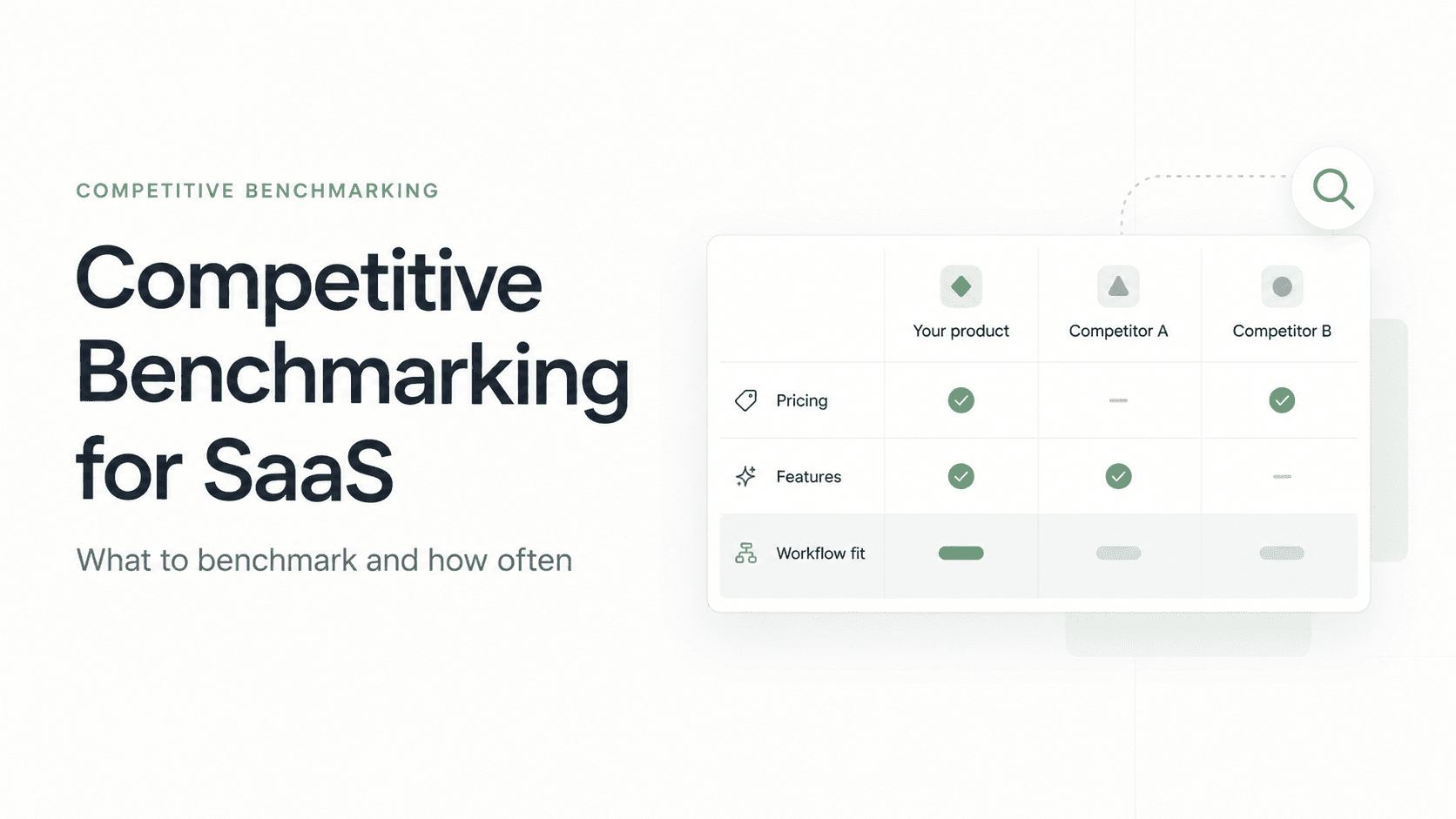
Most SaaS companies have a competitor comparison spreadsheet somewhere. It usually contains a list of competitors, their pricing plans, product features, and a few notes about what makes each product different.
The problem is that these spreadsheets often become outdated within weeks. Competitors introduce new features, change their pricing, or shift their positioning, while the information you've collected stays the same.
More importantly, comparing competitors across dozens of parameters doesn't necessarily help you make better decisions. A competitor having more features or a lower starting price doesn't automatically make its product a better alternative for your customers.
That's where competitive benchmarking becomes useful. Let's look at what you should benchmark, how often you need to update your research, and how to make those comparisons meaningful.
What is competitive benchmarking?
Competitive benchmarking is the process of comparing your business, product, or performance against competitors using a consistent set of criteria. For B2B SaaS companies, this typically involves evaluating pricing, product capabilities, positioning, target customers, and other factors that influence purchasing decisions.
Unlike general competitor research, benchmarking focuses on comparing specific areas using the same criteria. The objective is to understand where your product stands, identify meaningful gaps, and determine whether those gaps deserve attention.
For example, knowing that a competitor offers 50 features while your product offers 30 tells you very little. Understanding that it offers three capabilities that your target customers frequently request is considerably more useful.
What should SaaS companies benchmark against competitors?
You could compare competitors across dozens of categories, but maintaining that information takes time. For smaller B2B teams, I'd prioritize five areas.
1. Pricing and packaging
Start by comparing how competitors structure their pricing. Look at subscription prices, billing options, included features, usage limits, and the differences between plans.
Avoid comparing products solely by their starting prices. Two SaaS products charging $49/month might offer very different value depending on their usage restrictions, included capabilities, and additional charges.
Packaging is especially important because competitors can change their value proposition without adjusting the price. Moving a popular feature into a lower-tier plan, for instance, could make that offering more attractive to your prospects.
For a deeper look at pricing research, read our guide to competitor pricing for SaaS.
2. Product features and capabilities
Feature comparisons are probably the most common form of competitive benchmarking. Unfortunately, they're also easy to get wrong.
A spreadsheet containing hundreds of feature checkboxes might look comprehensive, but it rarely tells you which differences actually influence customer decisions.
With AI making certain software capabilities faster and cheaper to develop, feature parity is becoming easier to achieve in some categories. However, being able to replicate a competitor's feature doesn't necessarily mean you can replicate the value it delivers to customers.
Consider two products offering similar automation capabilities. One might require users to manually export data, configure integrations, and switch between multiple applications. The other could support the same task within an existing workflow, with fewer steps and less manual intervention.
Both products might have the same feature checked in your comparison sheet, but the customer experience could be significantly different. This is why I'd recommend evaluating features in the context of your ideal customer's (ICP) workflow. Understand what customers are trying to accomplish, how they currently perform that task, and where the competing solutions fit into their process.
Of course, feature parity still matters when certain capabilities are mandatory purchasing requirements. Missing SSO, a critical integration, or a required security capability could immediately disqualify a product.
The key is understanding which features are essential, which improve the customer's workflow, and which are merely nice-to-have.
3. Website messaging and positioning
A competitor's website can reveal how it wants customers to perceive its product. Benchmark its homepage messaging, primary value proposition, target audience, and the benefits it emphasizes.
For example, two competing products might offer similar capabilities but position themselves differently. One might focus on affordability and ease of use, while the other emphasizes enterprise security and customization.
Understanding these differences helps you identify where your own positioning is distinctive and where it overlaps with competitors. It can also reveal changes in the customer segments they're trying to attract.
4. Target customers and use cases
Not every company offering a similar product is competing for the same customers. That's why it's worth comparing the industries, company sizes, and use cases each competitor targets.
Look at their solution pages, customer stories, integrations, and product messaging. These can provide clues about the audiences they're prioritizing.
However, remember that a competitor publishing a new industry landing page doesn't necessarily mean it has established a strong presence in that market. Treat these observations as signals worth investigating rather than definitive conclusions.
5. Customer proof and differentiation
Finally, compare how competitors support their claims. Review customer testimonials, case studies, published outcomes, and other evidence they use to demonstrate value.
For example, if a competitor positions itself around faster implementation, look for case studies or customer evidence supporting that claim.
This helps you distinguish between what competitors promise and what they've publicly demonstrated. It also gives you a better understanding of which claims your own positioning needs to address.
How often should you benchmark competitors?
One mistake teams make is treating competitive benchmarking as a quarterly exercise where they spend several days updating every competitor spreadsheet.
A better approach is to review frequently changing information more often while revisiting broader strategic comparisons periodically.
Here's a schedule I'd recommend for smaller SaaS teams.
| Benchmarking area | Suggested frequency | What to check |
|---|---|---|
| Pricing and packaging | Weekly | Price changes, plans, features, and limits |
| Product capabilities | Monthly | New features, integrations, and releases |
| Website positioning | Monthly | Messaging, value propositions, and audiences |
| Target customers | Quarterly | Industries, company sizes, and use cases |
| Customer proof | Quarterly | New case studies, testimonials, and claims |
These are suggested review frequencies, not fixed rules. If you're preparing for a major product launch or frequently competing against a particular company, you might need more frequent comparisons.
How to create a competitive benchmarking scorecard
You don't need specialized software to start benchmarking competitors. A Google Sheet with a few relevant comparison criteria is enough for most small teams.
I'd recommend creating a table with your product and three or four direct competitors. Keep the criteria consistent so that you're comparing similar capabilities and customer requirements.
Here's a simplified example using fictional SaaS products.
| Benchmark | Your product | Competitor A | Competitor B |
|---|---|---|---|
| Target customers | SMBs | SMBs | Mid-market |
| Starting price | $49/mo | $39/mo | Contact sales |
| SSO availability | Higher-tier plan | Not verified | Included |
| Free trial | 14 days | 7 days | Demo required |
| Main positioning | Ease of use | Affordability | Enterprise security |
| Workflow fit | Native approval workflow | Requires manual handoffs | Configurable approvals |
| Purchase-critical capabilities | Key integrations included | One required integration is missing | Requirements appear covered |
P.S. This is just an illustrative example. Workflow and capability assessments should be validated against actual customer requirements.
Notice that the scorecard goes beyond comparing pricing and features. It also considers how well each product supports the customer's workflow and whether it meets the requirements that could influence a purchasing decision.
I'd avoid assigning arbitrary numerical scores to every category. Unless you've established clear evaluation criteria, giving one product an 8/10 and another a 6/10 creates an impression of precision that your research might not support.
Include links to your sources and the date each observation was verified. This makes it easier to revisit specific claims when competitors update their offerings.
How to turn competitive benchmarking into action
Collecting competitor information is relatively straightforward. Using it to make decisions is where things get interesting.
Let's say your benchmarking exercise reveals that two competitors now include a popular integration in their entry-level plans, while your product restricts it to a more expensive tier.
That finding alone doesn't mean you should immediately change your packaging. First, investigate whether the integration influences purchasing decisions, whether prospects have raised concerns, and how comparable the competing implementations are.
There's another factor worth considering: how deeply your product is embedded in the customer's existing workflow.
A competitor might replicate one of your most popular features within weeks. But that doesn't mean your customers will immediately switch.
They may have already built processes around your product, integrated it with other systems, trained their teams, and accumulated historical data. Switching could require changing several parts of their existing workflow, even when a competing product offers similar capabilities.
Similarly, a feature your competitor offers might be less valuable if customers need to introduce additional steps or workarounds to use it.
This is why competitive benchmarking should help you understand the customer's workflow, purchasing requirements, and switching considerations alongside traditional feature comparisons.
These findings can inform your positioning, sales objection handling, pricing decisions, and product priorities. But a competitor's advantage doesn't always represent a weakness in your product.
The most useful benchmarks are those that help your team decide what deserves attention and what can safely be ignored.
Common competitive benchmarking mistakes
Before wrapping up, there are three mistakes worth avoiding.
Comparing everything: Tracking dozens of features and capabilities creates unnecessary work. Prioritize the criteria that influence purchasing decisions and fit into your customers' workflows.
Taking competitor claims at face value: Marketing websites are useful research sources, but they're not independent verification. When possible, validate important claims through documentation, product trials, or customer feedback.
Never updating your research: A competitor comparison becomes less useful as the underlying information ages. Record when each benchmark was last verified and establish a manageable review schedule.
Make competitive benchmarking an ongoing practice
Competitive benchmarking doesn't need to be a complicated research project. Start with a few relevant competitors, identify the criteria your customers care about, and document how the products compare.
Keep your research updated as competitors change their products, pricing, and positioning. More importantly, evaluate those changes against your ICP's workflow and the problems they're trying to solve.
Over time, you'll have a clearer picture of where your product stands and which competitive developments deserve your attention. The real value comes from using those comparisons to support better positioning, pricing, product, and sales decisions.