Competitor Pricing for SaaS: How to Research It and When to React
Learn how to research competitor pricing, track SaaS pricing changes, and decide when your team should respond to changes in pricing, plans, and packaging.

Kaavian Sivam
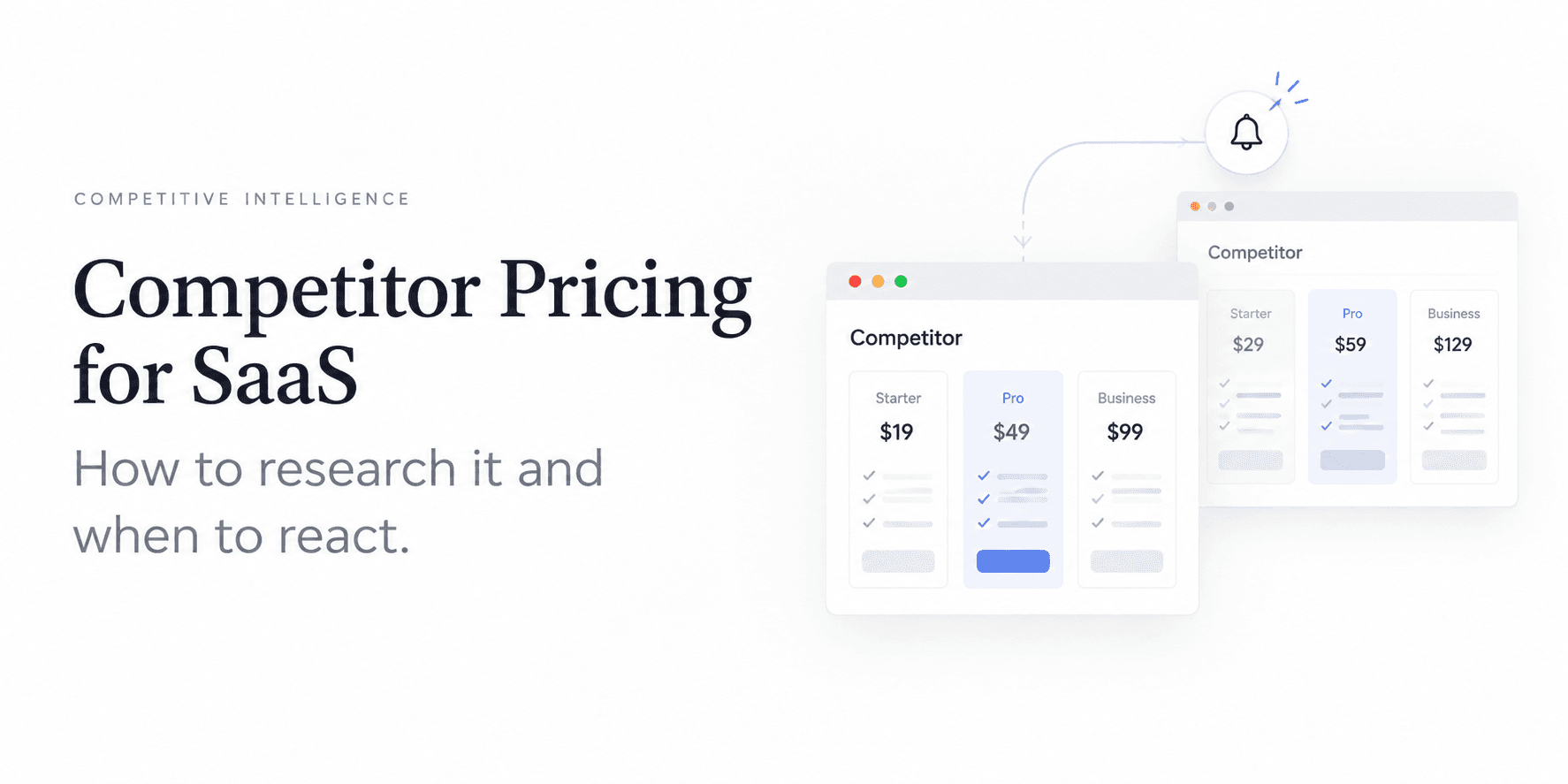
Imagine finding out that your competitor changed their pricing three weeks ago. You didn't notice. Your sales team didn't notice either.
You only discovered it because a prospect mentioned that your competitor now offers a feature on a cheaper plan.
This happens more often than you'd think.
SaaS companies regularly experiment with pricing, packaging, and feature availability. Some changes come with big announcements. Others quietly go live on a pricing page.
For product marketers and founders, keeping track of these changes is an important part of understanding where your product stands in the market.
But there's a bigger question: What should you actually do when a competitor changes their pricing?
Let's start with how to research it.
What is competitor pricing research?
Competitor pricing research involves studying how competing products are priced, packaged, and positioned.
In SaaS, this goes beyond comparing monthly subscription fees.
Consider two products that both cost $49/month. One offers unlimited users but restricts certain features to higher plans. The other includes those features but charges for additional seats.
The listed prices are identical, but the value customers receive can be quite different.
When researching competitor pricing, pay attention to:
- Pricing tiers: What does each plan offer, and who is it designed for?
- Feature availability: Which capabilities are included, restricted, or sold separately?
- Usage limits: Are there restrictions on users, credits, storage, or API calls?
- Billing options: How do monthly and annual subscriptions compare?
- Free plans and trials: What can customers experience before paying?
These details help you understand a competitor's pricing strategy and how they position their product against alternatives.
How to research your competitors' pricing
You don't need an elaborate competitive intelligence program to get started. A simple, repeatable process works well for most small SaaS teams.
1. Start with competitors you actually lose deals to
Tracking every company in your category is unnecessary.
Start with three to five competitors that regularly appear in sales conversations, customer evaluations, or product comparisons.
If you don't know who they are, ask your sales team which alternatives prospects mention most frequently.
These are the companies whose pricing decisions are most likely to affect your business.
2. Document their current pricing
Create a simple spreadsheet with each competitor's pricing tiers, subscription fees, included features, and usage limitations.
Pay particular attention to features that influence buying decisions.
For example, if integrations are frequently discussed during your sales calls, track which integrations competitors offer across their pricing tiers.
This gives you a baseline for future comparisons.
3. Look beyond the pricing page
Pricing changes don't always involve changing a dollar amount.
A competitor might introduce a new add-on, remove usage restrictions, or move a popular feature into a different plan.
Check their product changelogs, release announcements, help documentation, and promotional pages.
Together, these sources provide a clearer picture of their pricing and packaging decisions.
4. Track what changes over time
A spreadsheet captures what competitors charge today. It won't tell you what changed last week unless someone manually checks and updates it.
This is where automated competitor price monitoring becomes useful.
Monitoring tools like Ulavu can capture changes to competitor websites and alert you when their pricing pages are updated.
Instead of repeatedly checking the same websites, your team can spend more time understanding changes that matter.
What can competitor pricing changes tell you?
Here's where competitor pricing research gets interesting.
A pricing change can reveal something about a company's broader strategy. However, the change itself rarely tells the whole story.
Consider a few possibilities.
A competitor introduces a cheaper entry-level plan.
They might be targeting smaller businesses or trying to reduce the barrier to adoption.
A competitor moves features into higher-priced plans.
They could be experimenting with monetization or encouraging existing customers to upgrade.
A competitor increases annual subscription discounts.
They might be trying to encourage longer commitments or improve revenue predictability.
Each change offers a possible explanation, but none is conclusive.
Look for supporting evidence in product announcements, customer feedback, and sales conversations before drawing conclusions.
After all, competitor pricing intelligence is only useful when you can connect what changed to what it might mean for your business.
When should you react to a competitor's pricing change?
This is where many competitive intelligence programs fall short.
Teams collect plenty of information about competitors but struggle to decide what deserves attention.
A simple way to approach this is to classify pricing changes into three categories.
1. Ignore
Some changes have little relevance to your business.
If a competitor modifies an enterprise plan while your customers predominantly purchase self-service subscriptions, there may be no immediate reason to respond.
Document the change and move on.
2. Investigate
Some changes deserve attention but don't require immediate action.
For example, a competitor introducing a cheaper plan could affect your positioning.
Before responding, ask yourself:
- Does this plan target the same customers as ours?
- Are the features and usage limits actually comparable?
- Have prospects started mentioning this offering?
- Does this change affect how customers perceive our product's value?
The answers will help you determine whether the change represents a genuine competitive threat.
3. Act
Sometimes, pricing changes directly affect your ability to compete.
Perhaps prospects repeatedly question why your product costs more. Or a competitor starts including a capability that you've historically used as a differentiator.
These situations deserve a response.
But responding doesn't automatically mean reducing your prices.
You could update your competitive battlecards, improve sales objection-handling material, revisit your positioning, or make the value of your existing packages easier to understand.
Pricing changes are worth acting on when they meaningfully influence customer decisions.
Make competitor pricing research a recurring habit
Competitor pricing research shouldn't happen only when you're preparing for a product launch or responding to a lost deal.
Make it part of your regular competitive intelligence workflow.
Track a focused set of competitors, document meaningful changes, and review their potential impact alongside what you're hearing from customers and prospects.
Over time, you'll have a better understanding of how competitors evolve their pricing strategies and where your product stands.
And when a competitor makes an important change, you'll have the context to decide what to do about it.
Want to stop manually checking competitor pricing pages?
Ulavu monitors your competitors' websites, captures changes, and alerts you when something important happens. Starting at $10/month.