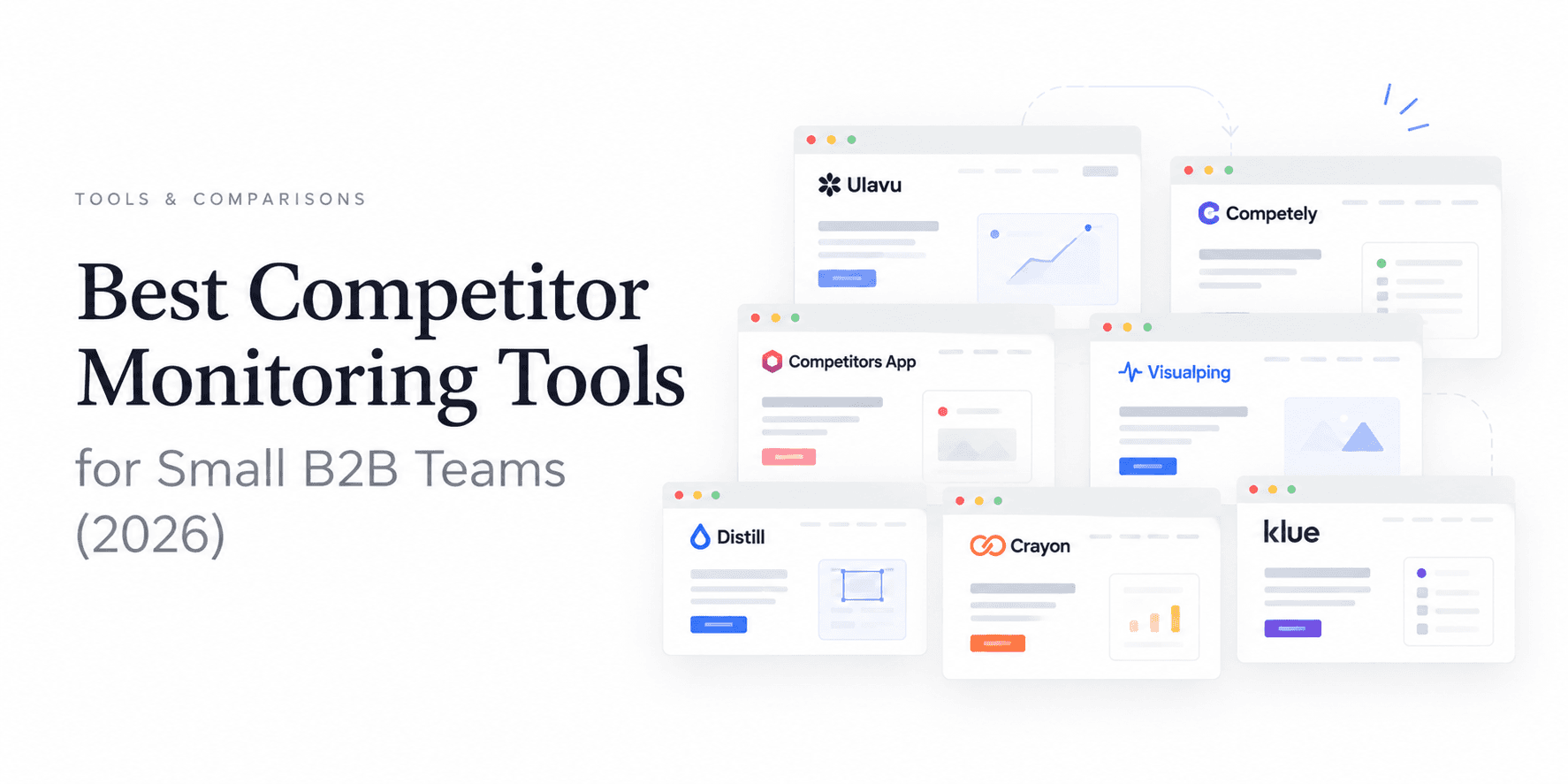
6 Best Competitor Monitoring Tools for Small B2B Teams (2026)
Comparing competitor monitoring tools? Explore 7 options for tracking competitor pricing, website changes, product launches, and more, with features and pricing.

Kaavian Sivam · Founder @ Ulavu
I've been caught off guard a few times when competitors changed their pricing, launched new features, or updated their positioning. Most of these changes happened right under my nose.
Back then, I maintained a spreadsheet with competitor information and manually visited their websites every few weeks. It worked for a while, but keeping everything updated became another task on an already long to-do list.
And when someone from sales needed an updated competitor comparison, I'd often find myself checking the same websites all over again. This is a familiar problem for product marketers and founders at smaller B2B companies.
You want to know what your competitors are doing, but you probably don't have a dedicated competitive intelligence team or the budget for an enterprise platform. Fortunately, there are several competitor monitoring tools that can help.
I've put together six options worth considering, from simple website monitors to full-fledged competitive intelligence platforms.
A quick disclosure: I'm building Ulavu, one of the products covered here. I haven't personally tested every tool on this list. The comparisons are based on publicly available product information, documentation, and pricing as of October 2026.
What should you look for in a competitor monitoring tool?
Before comparing tools, it's worth understanding what you actually need to monitor.
For most small B2B teams, I'd prioritize five things.
1. Website and pricing changes
Can the tool detect when competitors change their pricing, packaging, product messaging, or website content?
2. Product launches and announcements
Will you know when a competitor launches a feature, introduces a new product, or creates a landing page targeting your customers?
3. Useful alerts
Getting notified about every minor website change can quickly become annoying. Look for tools that help you identify meaningful updates.
4. Historical data
Can you see what a competitor's website looked like previously? This becomes useful when analyzing how their positioning or pricing has evolved.
5. Pricing and setup
A tool that requires weeks of implementation might be unnecessary if you're a two-person marketing team monitoring five competitors.
Keep these requirements in mind while evaluating the options below.
7 best competitor monitoring tools compared
Here's a quick comparison before we get into the details.
| Tool | Best for | Starting price | Primary strength | | -------------- | --------------------------------------------- | ------------------------- | --------------------------------------------- | | Ulavu | Small B2B marketing teams | $10/month | Website changes and AI analysis | | Competely | Structured competitor research | $39/month | Sourced competitive analysis and monitoring | | Visualping | Website change detection | Free; paid from $14/month | Visual and text change monitoring | | Distill | Custom website monitoring | Free; paid from $15/month | Flexible page monitoring and alert conditions | | Crayon | Established competitive intelligence programs | Custom pricing | Intelligence collection and sales enablement | | Klue | Competitive enablement and win-loss analysis | Contact sales | Battlecards, sales intelligence, and win-loss |
1. Ulavu: Best for focused competitor monitoring on a small budget

Of course, I'm going to start with Ulavu. :P
However, there is a reason to it rather than just doing it for awareness purposes.
Ulavu is a competitor monitoring tool built for marketers and founders who want to track meaningful changes across competing websites.
The idea is straightforward: Add your competitors, let Ulavu monitor their websites, and get notified when something important changes.
It captures website screenshots and helps identify updates to pricing, messaging, product pages, and other content. AI analysis provides additional context around detected changes, reducing the time spent manually comparing website versions.
Key features:
- Automated competitor website screenshots
- Website change detection and alerts
- Monitoring of pricing and product pages
- AI-generated change analysis
- Historical website captures
Pricing: Starts at $10/month.
Where it works well
Ulavu makes sense when your primary requirement is knowing when competitors change something on their websites. You don't have to build an elaborate competitive intelligence program or spend heavily to monitor a handful of important competitors.
Where it falls short
Ulavu is focused on public competitor activity. It doesn't replace sales enablement platforms that combine CRM data, win-loss interviews, internal competitive intelligence, and battlecard management.
If you're looking for those capabilities, consider Crayon or Klue.
Best suited for: Solo PMMs, SaaS founders, and small B2B marketing teams.
2. Competely: Best for structured competitor analysis
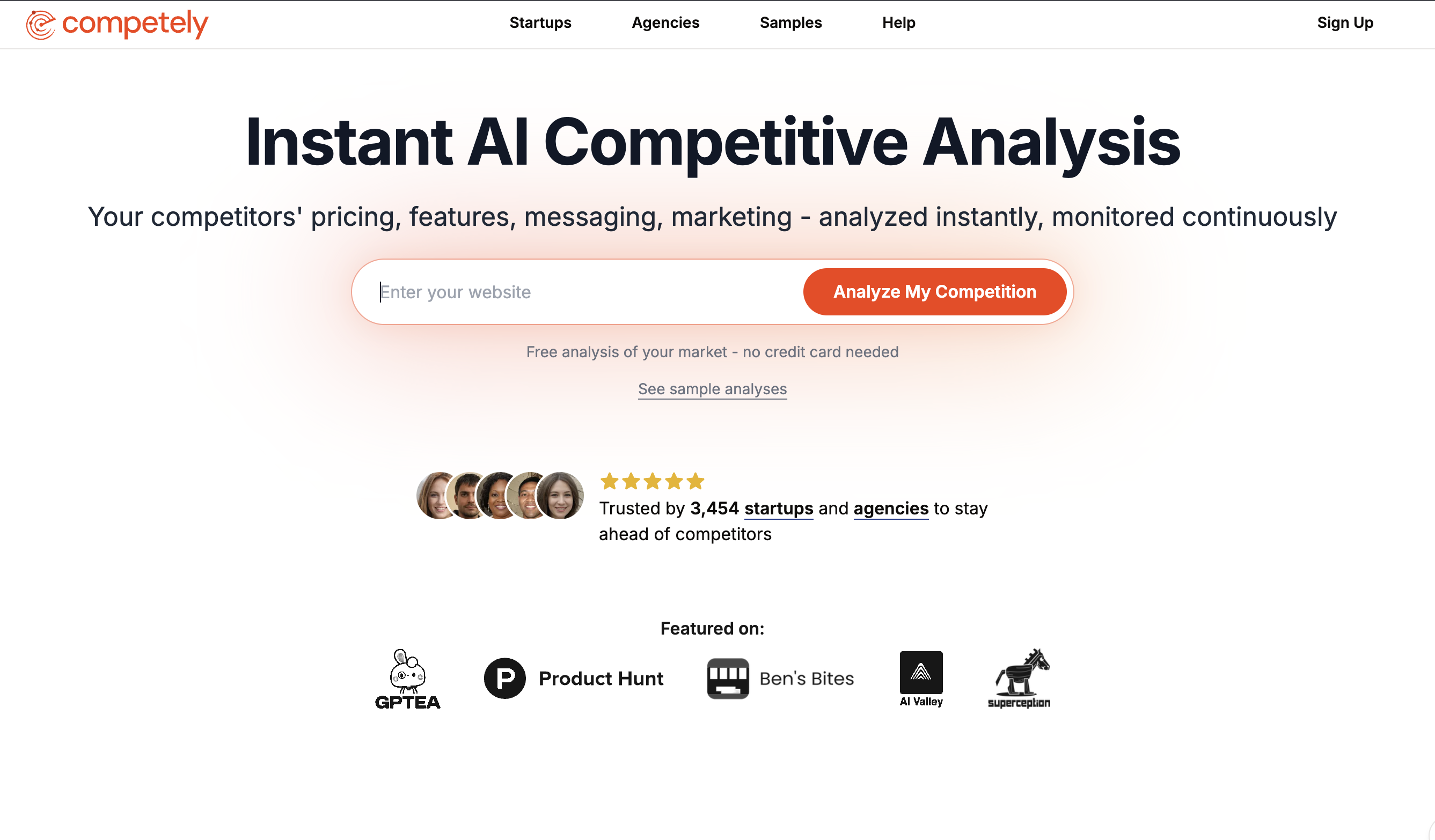
Competely is worth considering if you need a detailed competitive analysis alongside ongoing monitoring.
It analyzes competitors across multiple dimensions, including products, pricing, positioning, features, and target audiences.
One interesting capability is its source-backed research.
Competely says its analysis covers more than 100 data points per competitor, with links to the sources behind its findings.
It also monitors competitors and sends recurring briefs highlighting meaningful changes.
Key features:
- Structured competitor analysis
- AI-generated competitor research
- Pricing and positioning comparisons
- Recurring competitive briefs
- Source references and exportable reports
Pricing: $39/month for Starter, $59/month for Pro, and $99/month for Scale.
There is one detail worth considering: the $39 Starter plan provides competitive briefs every two weeks. Weekly briefs are available on higher plans.
Where it works well
Competely is particularly useful when you need to understand competitors in depth, prepare comparison documents, or research several companies.
Where it falls short
If you're primarily looking for frequent notifications about individual website changes, its scheduled brief approach may be less suitable than a dedicated page-monitoring tool.
Best suited for: Product marketers, consultants, and founders conducting structured competitor research.
3. Visualping: Best for monitoring specific website changes
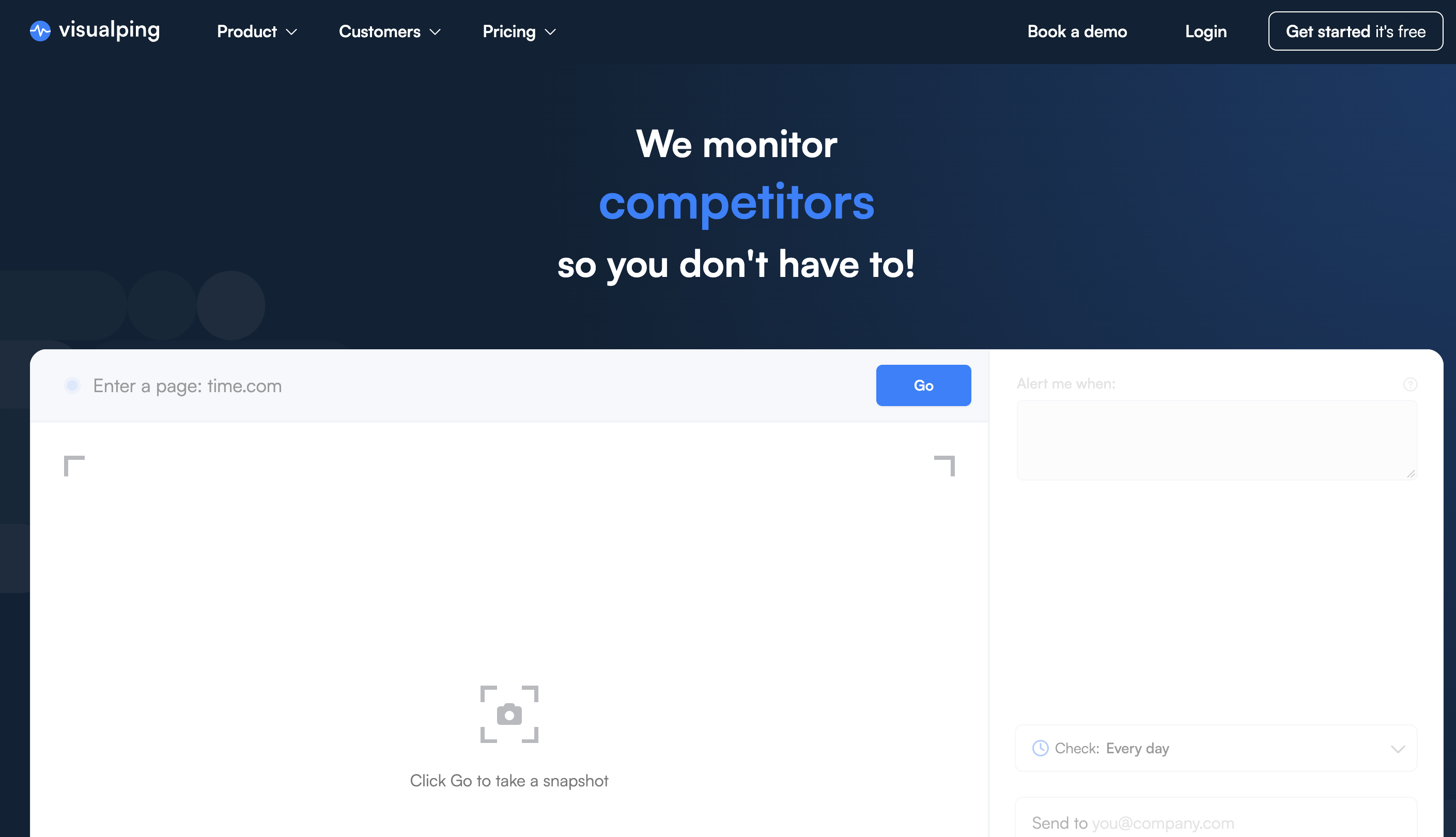
Visualping is an established website change monitoring tool. It lets you monitor entire webpages or specific sections and receive alerts when changes occur.
For example, you can configure Visualping to monitor a competitor's pricing table, product page, or announcement section.
The platform supports visual, text, and element change detection, along with AI-generated change summaries.
Key features:
- Visual and text change detection
- Monitoring of specific webpage elements
- AI change summaries
- Historical change comparisons
- Email notifications
Pricing: Free plan available. Paid plans start at $14/month, or $10/month with annual billing.
Where it works well
Visualping is a strong choice when you know exactly which webpages you want to monitor. Its free plan also makes it convenient for testing website monitoring before committing to a paid subscription.
Where it falls short
Visualping is primarily a general-purpose website monitoring platform. While it can identify and summarize changes, building a competitive intelligence workflow around those changes remains your responsibility.
Best suited for: Marketers who need reliable monitoring of specific websites or page elements.
4. Distill: Best for customizable website monitoring
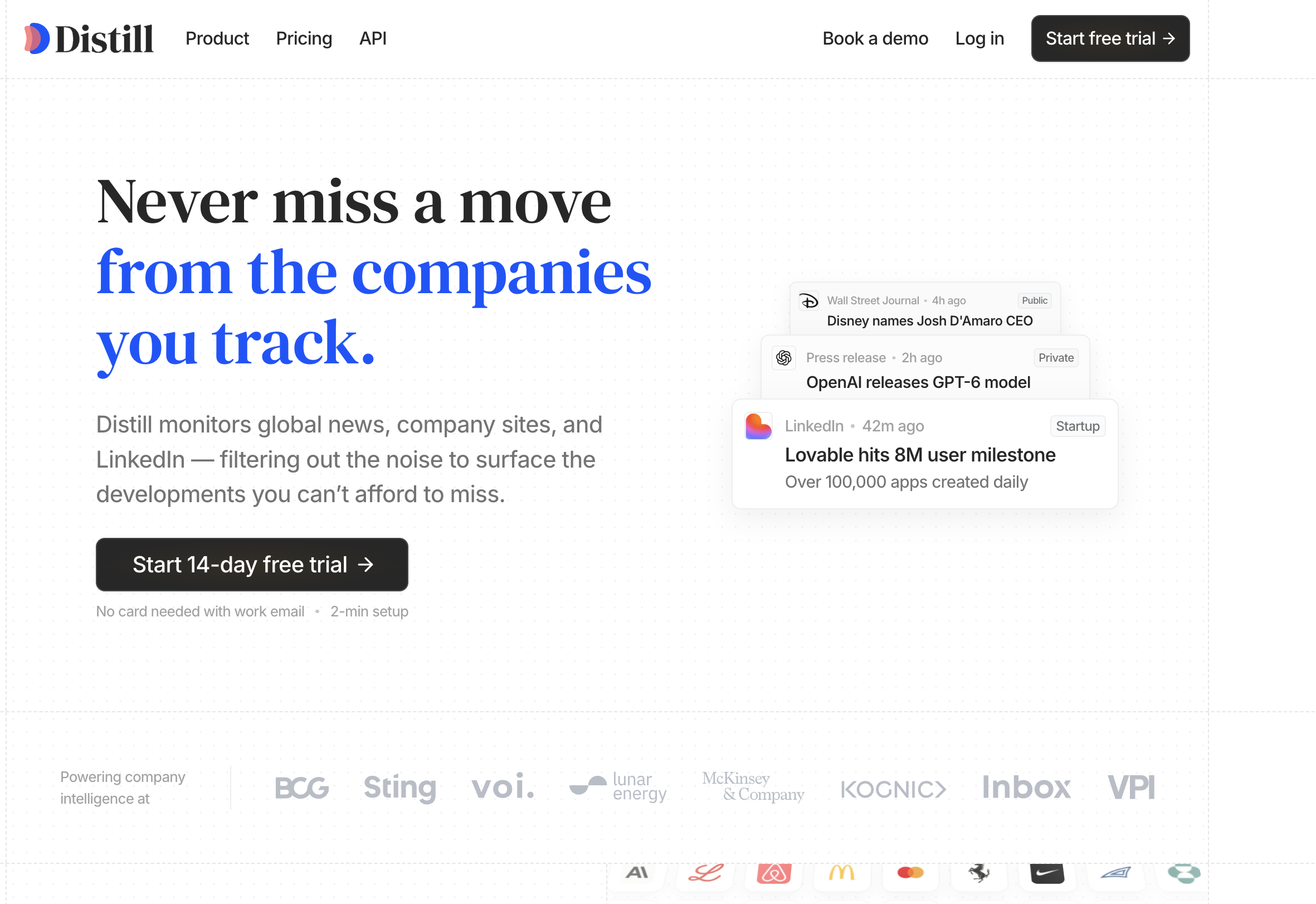
Distill is another website change monitoring tool, particularly useful when you want more control over what gets monitored.
You can select specific parts of a webpage, configure monitoring intervals, and define conditions for alerts. It also offers browser-based and cloud monitoring.
Key features:
- Website and webpage element monitoring
- Custom alert conditions
- Browser-based monitoring
- Cloud monitoring
- Email and webhook notifications
- Version history on paid plans
Pricing: Free plan available. Paid plans start at $15/month.
Where it works well
Distill is useful when you have specific monitoring requirements and want flexibility in how you configure them. For example, you might want alerts only when a particular section of a competitor's pricing page changes.
Where it falls short
Distill requires you to configure what to monitor. It's better suited for users comfortable setting up monitoring rules than for teams seeking an out-of-the-box competitive intelligence workflow.
Best suited for: Technical marketers, founders, and teams with specific website monitoring requirements.
5. Crayon: Best for established competitive intelligence programs
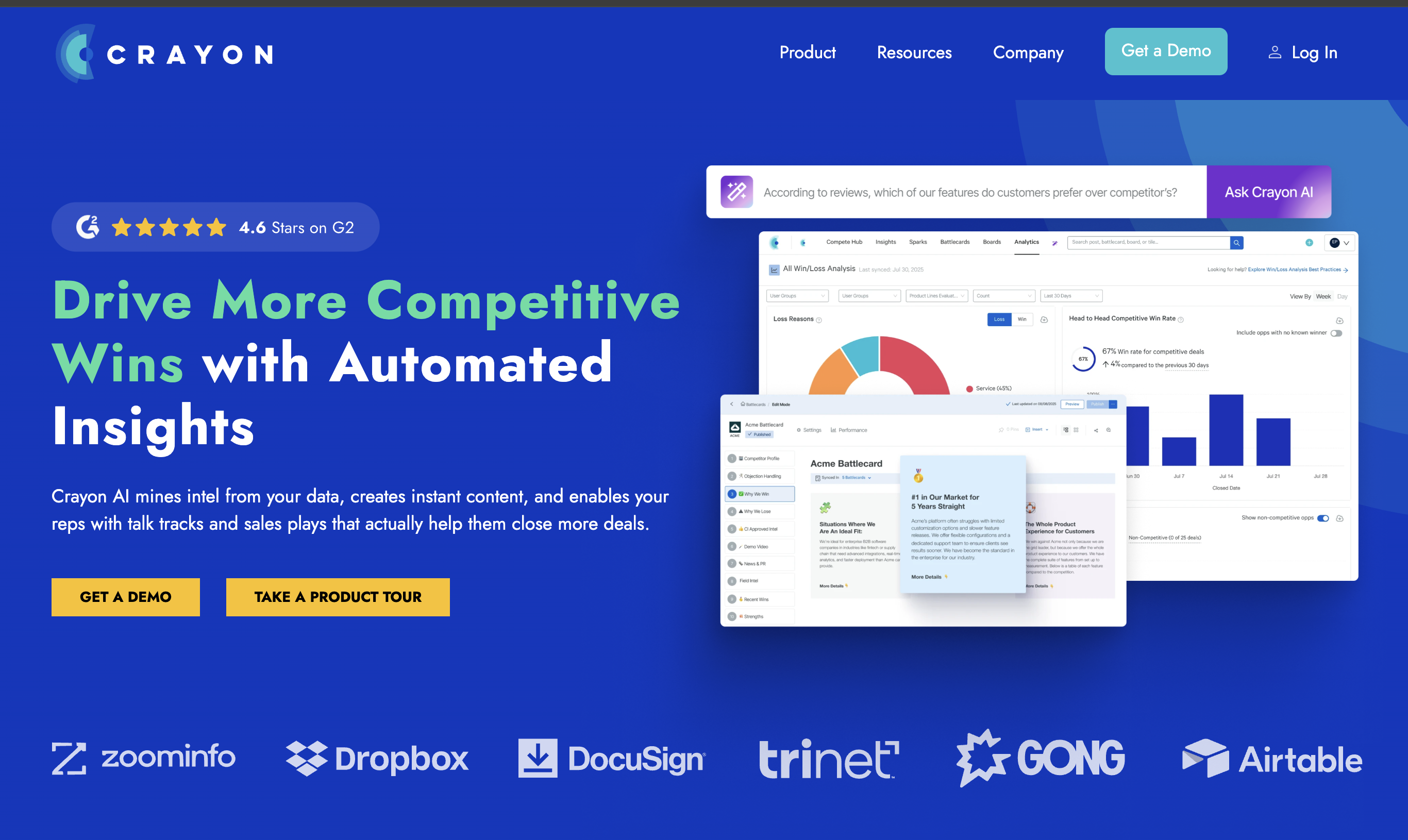
Crayon is a comprehensive competitive intelligence platform designed for organizations running structured competitive programs. It combines external competitor monitoring with internal competitive information from sales conversations and other company systems.
Crayon also helps teams turn competitive intelligence into materials that salespeople can use, including battlecards and competitive updates.
Key features:
- Competitor website and pricing monitoring
- Competitive intelligence aggregation
- AI-assisted competitor analysis
- Battlecard creation and updates
- Sales enablement integrations
- Competitive program analytics
Pricing: Custom pricing. Contact Crayon for a quote.
Where it works well
Crayon becomes valuable when competitive intelligence involves several teams and needs to influence sales conversations consistently.
Where it falls short
For a solo PMM or an early-stage startup, its broader implementation and sales enablement capabilities may be more than necessary.
Best suited for: Mid-market and enterprise B2B companies with established sales teams.
6. Klue: Best for competitive enablement and win-loss intelligence

Klue combines competitive intelligence with sales enablement and win-loss analysis. Like Crayon, it collects competitor information and helps teams organize and distribute it.
However, Klue places considerable emphasis on making competitive insights accessible to salespeople during active deals. Its capabilities include competitive battlecards, objection handling, and analysis of why deals are won or lost.
Key features:
- Competitor monitoring
- Competitive battlecards
- AI-assisted competitive research
- Sales enablement workflows
- Win-loss analysis
- CRM and collaboration integrations
Pricing: Contact sales for a quote.
Where it works well
Klue is particularly relevant when you have a growing sales organization and need to connect competitive intelligence with deal outcomes.
Where it falls short
If your immediate requirement is monitoring competitor website changes, Klue's broader capabilities may be unnecessary.
Best suited for: B2B companies with dedicated product marketing, competitive intelligence, and sales enablement functions.
Which competitor monitoring tool should you choose?
After looking at these seven tools, I'd narrow the decision down to the job you're trying to accomplish.
If you want affordable, focused competitor monitoring, consider Ulavu. It covers the essential website monitoring workflow without requiring a larger competitive intelligence setup.
If you need detailed competitor research: Competely is a strong option. Its structured analysis and sourced research can save time when preparing comparisons.
If you only need to monitor webpages, Visualping and Distill are both worth evaluating. Visualping offers AI summaries and straightforward page monitoring, while Distill provides more granular configuration options.
If you're running an established competitive intelligence program, Crayon and Klue offer capabilities that go beyond monitoring, particularly around sales enablement and competitive deal intelligence.
There's little reason to pay for a comprehensive enterprise platform if you're only tracking changes across five competitor websites.
Equally, a basic website monitor won't solve your problem if your sales team needs updated battlecards, win-loss insights, and deal-specific competitive recommendations.
Choose based on how the information will be used.
How to evaluate a competitor monitoring tool before paying
I'd suggest running a small test before choosing any platform. Pick three competitors and identify the pages that matter most: their homepage, pricing page, and primary product pages. Add those pages to your shortlisted tools. Then evaluate how well each tool handles the following:
- Setup: How much time does it take to start monitoring?
- Accuracy: Can you verify the changes against the original website?
- Alert quality: Are the notifications useful, or do they create additional work?
- History: Can you easily review previous changes?
- Cost: What will you pay to monitor all your relevant competitors?
One important consideration is monitoring frequency. Some tools check websites frequently, while others provide weekly or fortnightly summaries. Make sure the tool's monitoring schedule matches how quickly you need to respond. And remember that detecting a website change is only the first step.
Your team still needs to decide whether that change affects your positioning, product strategy, or sales conversations.
Final thoughts
If there's one thing I've learned from working in product marketing, it's that keeping track of competitors is easy to deprioritize. There's always another launch, campaign, sales request, or positioning exercise demanding attention.
Competitor research often becomes something you do when there's an immediate need. The problem is that your competitors aren't waiting for you to finish your other work. They'll continue changing their products, pricing, and messaging.
Having a system that keeps you informed makes a difference, even if you're a team of one. And you don't necessarily need a large budget to build that system.